The OODA Loop and Making Decisions Under Pressure
· 2 min read
The call comes in at 11pm.
Something is wrong in production. The alerts are noisy, Slack is moving fast, and the team is waiting for someone to help make sense of the situation.
I have been in that kind of moment enough times to know this: waiting until everything is clear is usually not an option.
That is why I like the OODA Loop.
OODA stands for Observe, Orient, Decide, Act. It was developed by Colonel John Boyd, a US Air Force pilot and military strategist, to explain how fighter pilots make decisions in close combat.
The basic idea is simple. The pilot who moves through the loop faster has the advantage. The other pilot is always reacting late and eventually loses control of the situation.
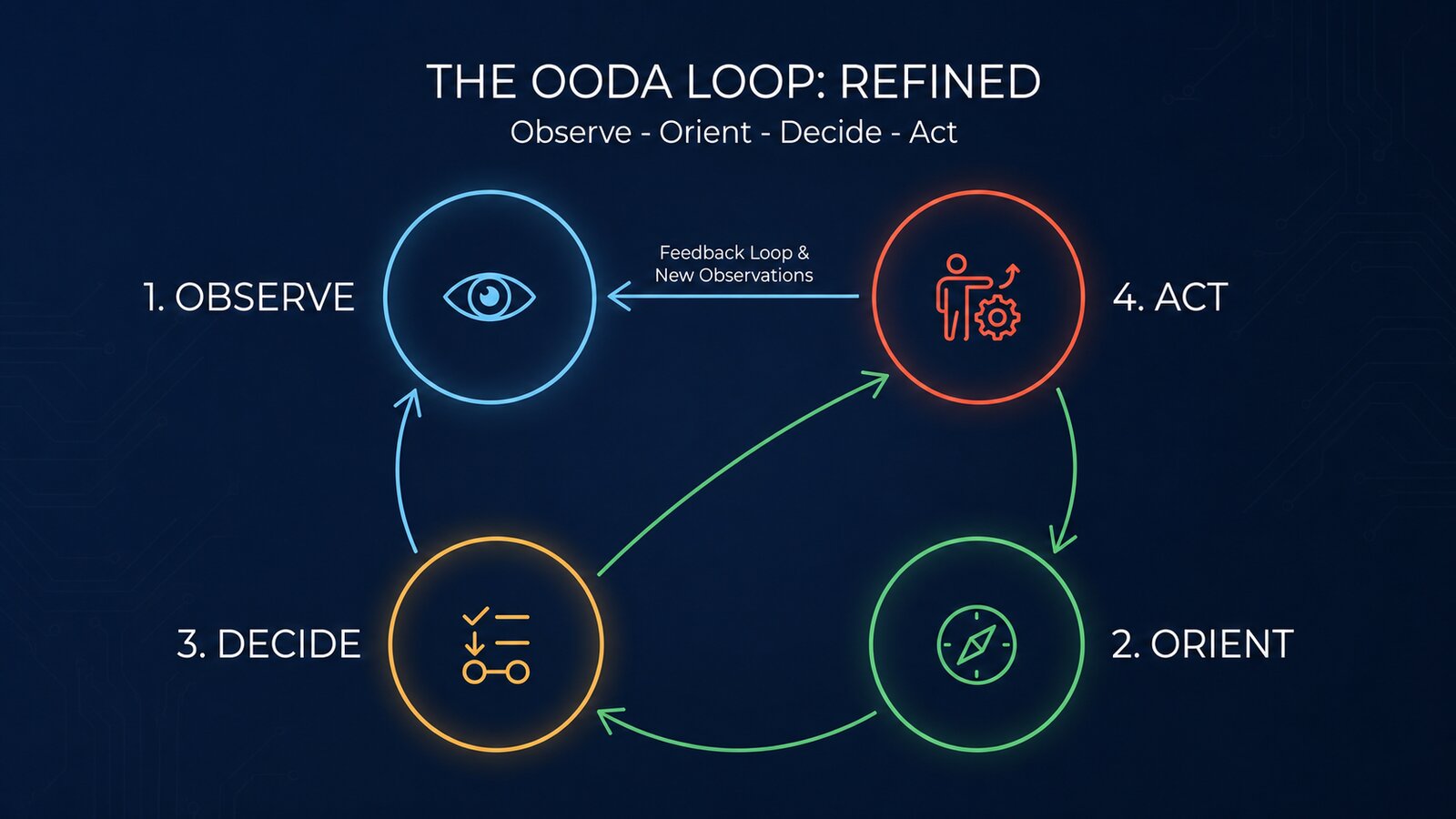
I am not flying fighter jets, of course, but the idea maps surprisingly well to engineering work.
The Four Steps
Observe. Look at what is actually happening. Not what you expected. Not what you are afraid is happening. What are the signals right now? Are error rates going up? Is one service failing? Did a team member suddenly go quiet in stand-up? Start with the facts you have.
Orient. This is the step I think people skip the most. It means making sense of what you saw using your experience, your mental models, and the context around you. Two managers can look at the same incident and read it very differently, mostly because they have lived through different things. Boyd saw this as the most important part of the loop.
Decide. Pick a direction. Not the perfect one. The best one you can choose with what you know right now. In these moments, waiting for the perfect answer can be worse than making a decent call.
Act. Do it. Then watch what happens next. The loop starts again.
Why it matters for engineering managers
Some decisions give you time to think. Many management decisions do not.
As an engineering manager, you often have to decide with incomplete information. A team conflict shows up late in the week. A production issue is getting worse. A stakeholder asks for something, but the request does not quite match the problem they are describing.
In those situations, I don’t think the OODA Loop gives you an answer. That is not the point.
What it gives you is a way to keep moving without pretending you know everything. Observe what is in front of you. Orient based on context. Decide with the information you have. Act, then pay attention to what changed.
The value is not in getting every step perfect. The value is in cycling through the steps honestly and adjusting as reality gives you more information.
Sometimes that is enough to calm the room down and help the team take the next useful step.
I hope this was useful for you, Rodolfo