Action-Centred Leadership Model
· 1 min read
This leadership model came across a conversation with someone another day. After that conversation I was thinking about an example to use and write about it.
Think about a specific situation where you might have a project where the pressure to ship is intense. The deadline is real, the stakeholders are watching, and you locked in on the tasks. The project gets shipped, but one person leaves the team a month later.
Then, you might think: I had the task part figured out. Team and individual, not so much. That is where John Adair’s model comes in.
The Three Circles
John Adair was a British leadership thinker who developed what he called Action-Centred Leadership in the 1970s. The model is simple: three overlapping circles, each one representing something a leader needs to pay attention to.
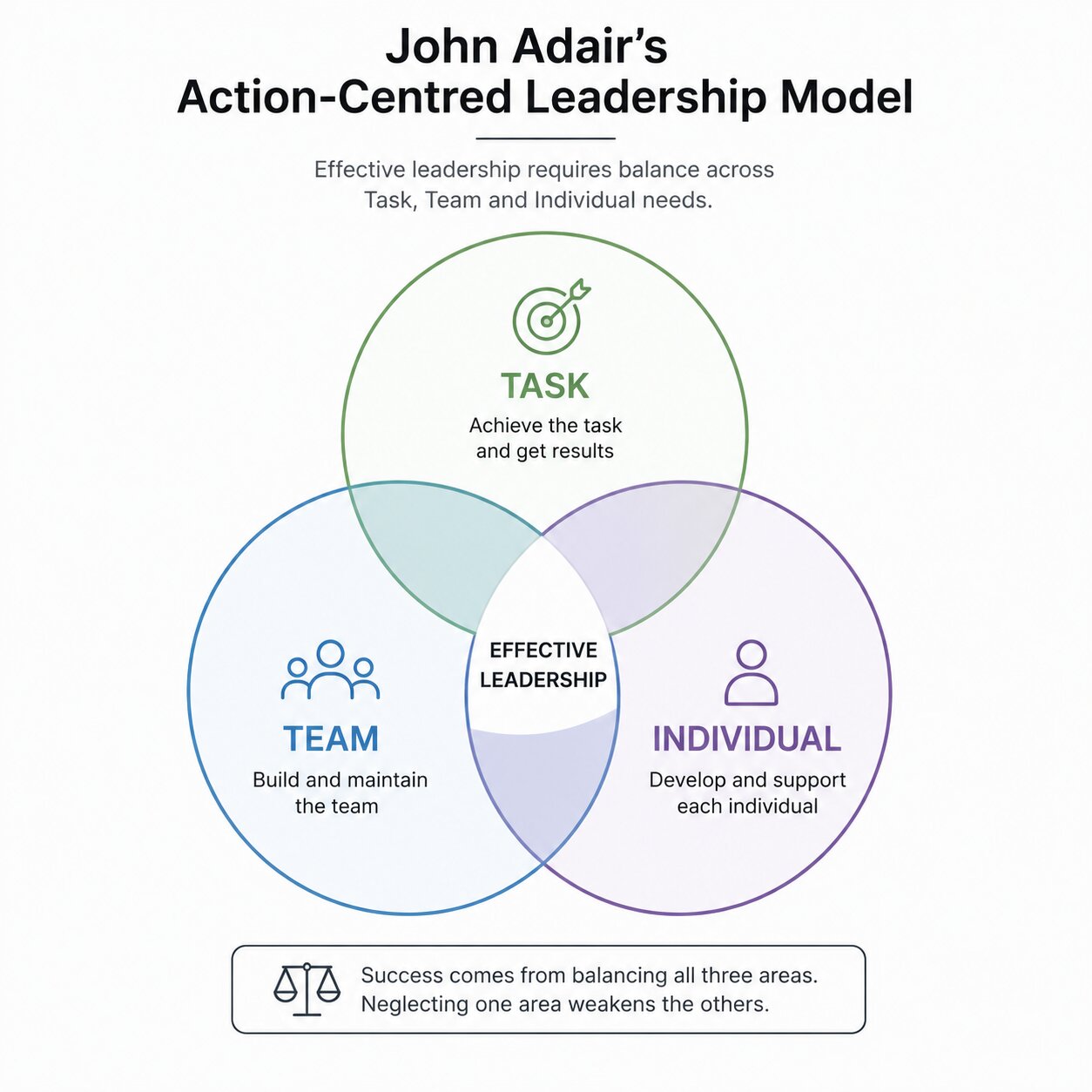
Task. Getting the work done. Hitting the goal. Delivering what was promised.
Team. Keeping the group working well together. Communication, morale, trust.
Individual. Each person on the team has their own needs, growth, and motivations.
The circles overlap because they affect each other. If you ignore the individual, the team suffers. If the team is falling apart, the task will too. You cannot just pick one and call it good.
A concrete example
Imagine a sprint is running behind. The task pressure is high.
A manager who only looks at the task might push the team harder, cancel one-on-ones, skip the retro. The sprint might even finish on time. But the team pays a price.
A manager who balances all three slows down for a moment to ask what is blocking people. They check in with the person who has been quiet all week. They make sure the goal is still clear. Then they push.
The sprint result might be the same, but the team on the other side of it is still functional. Still motivated. Still there.
Why it stuck with me
Most leadership models are either too simple or too complicated to remember in the middle of a hard week.
This one is different. Three circles. Task, team, individual. You can draw it on a whiteboard in thirty seconds.
The question it keeps asking is: which circle am I ignoring right now?
That is a useful question. More often than not, you already know the answer.
I hope this was useful for you, Rodolfo